
Are life settlement proceeds taxable? In many cases, at least a portion of the proceeds from selling a life insurance policy may be subject to federal income tax. The amount that may be taxable depends on factors including how much you paid into the policy, the policy’s cash surrender value, and the amount you receive from the life settlement. Viatical settlements involving qualifying terminally or chronically ill insureds may receive different tax treatment.
The information provided here is for general informational purposes only and should not be considered tax advice. Tax treatment can vary based on the policy, transaction, and individual circumstances, and the amount you receive from a life settlement is not necessarily the same as the amount on which you may owe taxes. Always consult your trusted tax professional for guidance regarding your unique situation.
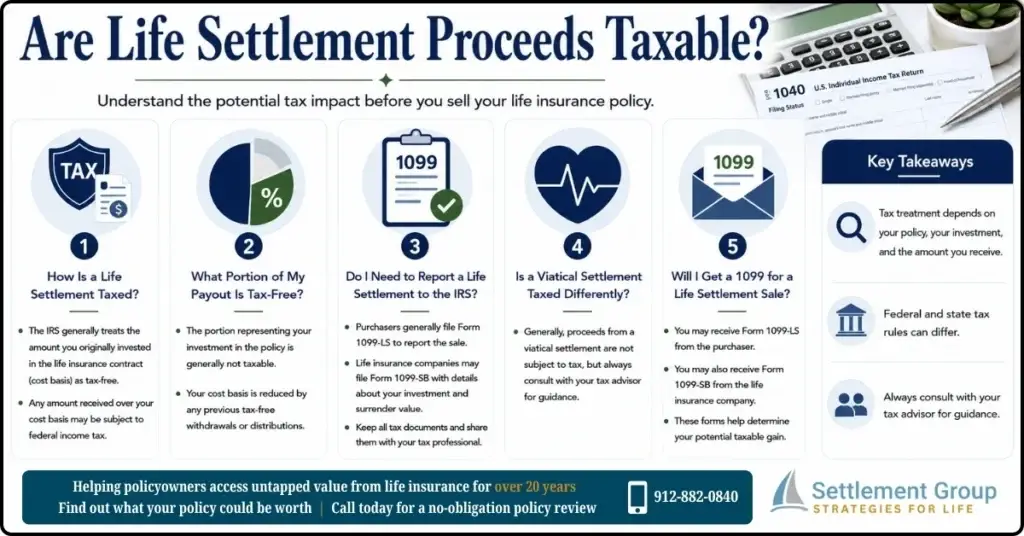
How Is a Life Settlement Taxed?
A life settlement involves selling an existing life insurance policy to a third-party purchaser. If you’re unfamiliar with how does a life settlement work, the policy owner receives an agreed-upon cash payment and transfers ownership and beneficiary rights to the purchaser. The purchaser then becomes responsible for future premiums and receives the death benefit when the insured passes away.
For federal tax purposes, the amount you originally invested in the life insurance contract is important when determining the potential taxable gain. The IRS generally defines the original policy owner’s investment in the contract as premiums or other consideration paid for the policy, reduced by certain amounts previously received tax-free from the contract.
The tax calculation can depend on the specific policy and transaction, so the entire life settlement payment should not automatically be treated as either taxable or tax-free.
What Portion of My Payout Is Tax-Free?
Generally, the portion of the proceeds representing your investment in the life insurance contract, commonly referred to as your cost basis, is not treated as taxable gain.
For example, if you have paid premiums into a policy for many years, those payments may contribute to your investment in the contract. However, previous withdrawals, distributions, or other transactions involving the policy can affect that amount.
The life insurance company may provide information about your investment in the contract and the amount you would have received if you had surrendered the policy at the time of the sale. For a reportable policy sale, this information is reported by the issuer on Form 1099-SB.
Because the calculation depends on the individual policy, policy owners should not assume that a particular percentage of every life settlement is tax-free.
Do I Need to Report a Life Settlement to the IRS?
Life settlement transactions can be subject to federal information-reporting requirements.
Under current IRS rules, the purchaser of an interest in a life insurance contract generally files Form 1099-LS for a reportable policy sale. The form reports information including the amount paid to the payment recipient and the date of the sale.
The life insurance company may also file Form 1099-SB, which reports the seller’s investment in the contract and the policy’s surrender amount.
These reporting requirements allow the IRS to receive information about the transaction. Policy owners should keep the tax documents they receive and provide them to the tax professional preparing their return.
Is a Viatical Settlement Taxed Differently Than a Life Settlement?
Yes, a qualifying viatical settlement can receive significantly different federal tax treatment.
Under federal tax rules, certain amounts received through a viatical settlement may be excluded from gross income when the insured is terminally or chronically ill and the applicable requirements are satisfied.
For federal tax purposes, a terminally ill individual is generally someone who has been certified by a physician as having an illness or physical condition that can reasonably be expected to result in death within 24 months of certification. Qualifying amounts involving a terminally ill insured may be fully excluded from gross income. Different limitations can apply when the insured is chronically ill.
The purchaser must also meet the federal requirements for a viatical settlement provider for the applicable exclusion to apply.
Because of these requirements, a transaction being described as a “viatical settlement” does not by itself determine its federal tax treatment.
Will I Get a 1099 for a Life Settlement Sale?
You may receive tax reporting documents related to the sale of your life insurance policy.
For a reportable policy sale, the purchaser generally files Form 1099-LS, Reportable Life Insurance Sale. This form reports the amount paid to the payment recipient and the date of the sale. A copy or acceptable substitute is generally provided to the payment recipient.
You may also receive Form 1099-SB, Seller’s Investment in Life Insurance Contract, from the life insurance company. This form reports the insurer’s information about your investment in the contract and the amount you would have received if you had surrendered the policy on the date of the sale.
Keep these documents with your tax records because they contain information that may be needed to determine the tax consequences of the transaction.
Does State Tax Treatment Differ?
It can. Federal income tax rules do not necessarily determine how a life settlement will be treated for state tax purposes.
State income tax laws vary, and your individual circumstances may also affect the result. A qualified tax professional can help you understand both federal and applicable state tax consequences before you complete the transaction.
Understand the Potential Tax Impact Before Selling Your Policy
Taxes are one consideration when deciding whether to sell a life insurance policy, but they should be considered alongside the amount you may receive, the policy’s surrender value, future premium obligations, and whether you still need the coverage.
Settlement Group can evaluate your policy and determine whether it may qualify for a life settlement. Settlement Group does not provide tax advice, so policy owners should consult their trusted tax professional regarding the tax consequences of their individual transaction.
Call us today for a no-obligation policy review. 912-882-0840