
Life Settlement vs Surrender Value
When comparing life settlement vs surrender value, the difference can be significant. For policy owners who qualify, a life settlement may provide substantially more than surrendering the policy.
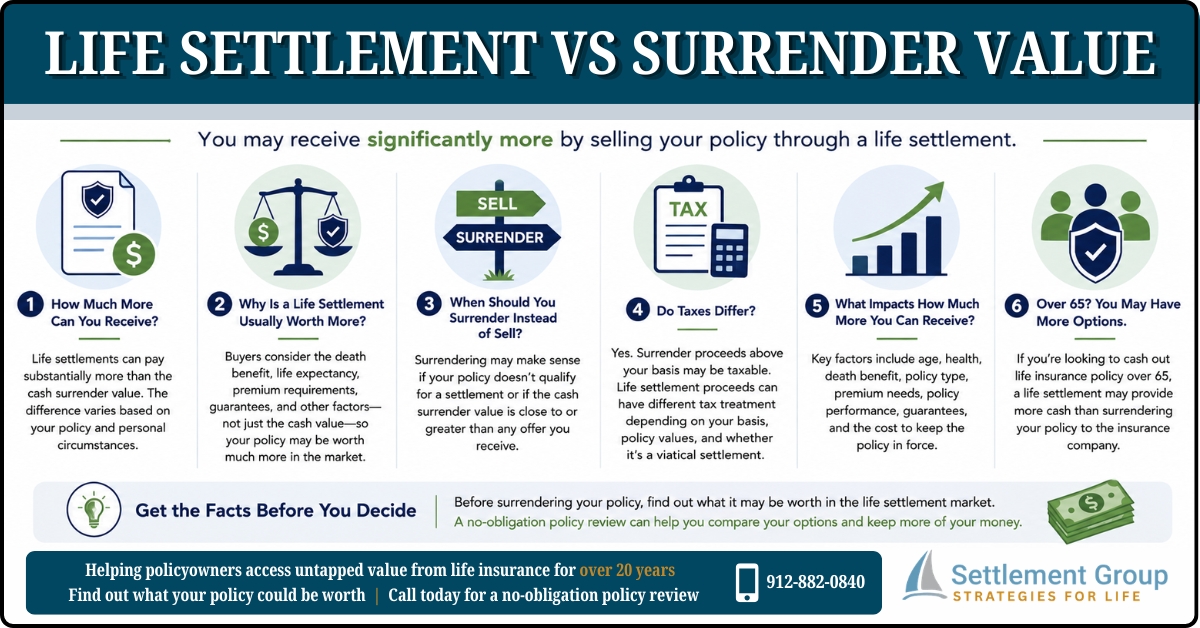
When comparing life settlement vs surrender value, the difference can be significant. Surrendering a life insurance policy means returning it to the insurance company in exchange for its available cash surrender value. A life settlement involves selling a qualifying policy to a third-party buyer for a lump sum cash payment. For policy owners who qualify, a life settlement may provide substantially more than surrendering the policy.
Before surrendering or allowing a life insurance policy to lapse, it is always worth finding out whether the policy has value in the life settlement market.
How Much More Is a Life Settlement Than the Cash Surrender Value?
There is no set amount or percentage that a life settlement will pay above a policy’s cash surrender value. Every policy is evaluated individually, and the difference can vary considerably.
A policy with little or even no cash surrender value may still have value to a life settlement purchaser. Conversely, a policy with substantial cash value does not automatically qualify for a significantly higher settlement.
A potential purchaser evaluates factors such as:
- The insured’s age and health
- The policy’s death benefit
- Current and future premium requirements
- The type of life insurance policy
- Policy guarantees and performance
- The expected cost of keeping the policy in force
- Other underwriting considerations
If the policy meets a purchaser’s criteria, they may present a cash offer. The policy owner can then compare that amount with the available cash surrender value before deciding what to do.
Why Is a Life Settlement Usually Worth More Than Surrendering?
The two transactions value a life insurance policy differently.
Cash surrender value is the amount available from the insurance company when the policy owner voluntarily terminates the coverage. It is generally based on the policy’s accumulated cash value after applicable surrender charges, loans, or other adjustments.
A life settlement purchaser evaluates the policy as an asset with a future death benefit. The purchaser considers the amount of that benefit along with the insured’s life expectancy, future premiums, policy guarantees, and the expected cost of maintaining the coverage.
Because a life settlement considers factors beyond the policy’s accumulated cash value, a qualifying policy may be worth substantially more in the secondary market than its cash surrender value.
When Does It Make Sense to Surrender Instead of Sell?
Selling is not necessarily the better choice in every situation.
Surrendering may make more sense if the policy does not qualify for a life settlement or if its cash surrender value is close to or greater than the amount a purchaser is willing to pay.
The important point is to know what the policy may be worth before making an irreversible decision. Once a policy has been surrendered or allowed to lapse, the opportunity to sell that coverage is generally gone.
Does Surrendering a Policy Trigger Different Taxes Than Selling It?
Potentially. The tax treatment of surrendering a life insurance policy and selling one through a life settlement can be different.
When a policy is surrendered, any amount received above the policy owner’s cost basis may generally be subject to income tax.
The taxation of life settlement proceeds can be more complex. Depending on the policy owner’s basis, the policy’s cash surrender value, and the amount received from the sale, portions of the proceeds may receive different tax treatment.
Special tax rules may also apply to certain viatical settlements involving an insured who is terminally or chronically ill. A viatical settlement company can tell you which type of settlement you qualify for.
Because tax consequences depend on the individual policy and circumstances, policy owners should consider the potential tax impact when comparing the net amount they could receive from surrendering or selling a policy. Always consult with your trusted tax professional.
What Factors Affect How Much More a Life Settlement Pays vs. Surrender?
The difference between a life settlement offer and cash surrender value depends largely on how a potential purchaser evaluates the policy.
Important factors include the insured’s age and health, death benefit, policy type, premium requirements, and the amount of money required to maintain the policy.
For example, a policy with a large death benefit and relatively favorable future premium requirements may be more attractive to a purchaser than a policy that requires substantial premiums to remain in force.
Life expectancy also plays an important role. A purchaser considers how long they may need to pay premiums before eventually receiving the death benefit.
Cash surrender value is only one part of this evaluation. This is why two policies with similar surrender values can receive very different life settlement offers.
Can I Cash Out a Life Insurance Policy Over 65?
If you’re looking to cash out life insurance policy over 65, surrendering the policy is not necessarily the only way to access its value.
Older policy owners may also qualify to sell their coverage through a life settlement. Eligibility is not based on age alone. Health, death benefit, policy type, premium requirements, and other factors are also considered.
Depending on the policy, selling it may provide more cash than surrendering it to the insurance company. Having the policy evaluated before surrendering it allows you to know whether another source of value may be available.
What Happens to the Policy After a Life Settlement?
When a life insurance policy is sold, ownership and beneficiary rights are transferred to the purchaser.
The purchaser becomes responsible for future premiums required to keep the policy in force and receives the death benefit when the insured passes away. The original policy owner receives the agreed-upon settlement payment and no longer owns the policy.
This is fundamentally different from surrendering the policy. With a surrender, the coverage is terminated by the insurance company and no future death benefit is paid.
Compare Your Life Settlement Value Before Surrendering Your Policy
If you are considering surrendering a life insurance policy, having it evaluated first by a licensed life settlement provider can help you understand whether it may have additional value.
Settlement Group can review your policy and determine whether it may qualify for a life settlement. If it does, you can compare a potential settlement offer with the policy’s cash surrender value before deciding what to do.
Contact us today for a no-obligation policy review. (754) 296-9034