
Life Settlement Calculator
A life settlement calculator can provide a preliminary idea of whether your life insurance policy may have value in the secondary market, but no calculator can determine exactly what a purchaser will offer.
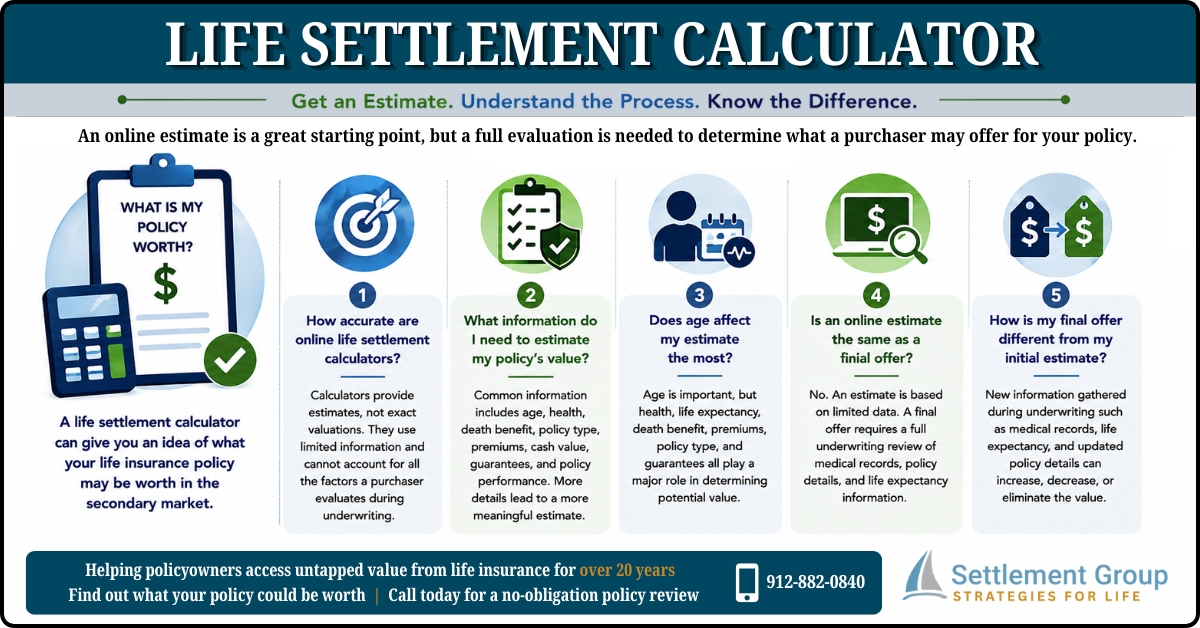
A life settlement calculator can provide a preliminary idea of whether your life insurance policy may have value in the secondary market, but no calculator can determine exactly what a purchaser will offer. The value of a life insurance policy depends on the insured’s age and health, the death benefit, future premium requirements, policy type, and other factors that require an individual review.
If you’re asking how much is my life insurance policy worth, an online estimate can be a useful starting point. A complete policy and medical review is needed before a potential purchaser can determine whether the policy qualifies and what they may be willing to pay for it.
How Accurate Are Online Life Settlement Calculators?
Online life settlement calculators are designed to provide estimates, not exact valuations.
Some calculators use only a few pieces of information, such as age and death benefit, while others consider additional factors. The fewer details a calculator considers, the more limited its estimate is likely to be.
Even a detailed calculator cannot account for everything a potential purchaser evaluates during underwriting. Medical records, policy illustrations, premium schedules, policy guarantees, and other information can significantly affect a policy’s value.
For this reason, a calculator is best used as an initial screening tool rather than a prediction of your final offer.
What Information Do I Need to Estimate My Policy’s Value?
The more information available about the insured and the policy, the more meaningful an initial estimate can be.
Information commonly used to evaluate a life insurance policy includes:
- The insured’s age
- General health information
- The policy’s death benefit
- The type of life insurance policy
- Current premium payments
- Future premium requirements
- Cash surrender value, if any
- Policy guarantees
- Policy performance and current status
A preliminary estimate may be possible without every piece of information. However, additional policy and medical information will generally be required before a potential purchaser can complete an evaluation.
Does Age Affect My Estimate the Most?
Age is important, but it is not the only factor that determines the potential value of a life insurance policy.
Life settlement purchasers consider the insured’s age together with their health and estimated life expectancy. Two people of the same age can have very different health histories and life expectancies, which can result in very different evaluations.
The policy itself is equally important. A purchaser also considers the death benefit, premiums required to maintain the policy, policy guarantees, and other features that affect the expected cost of keeping the coverage in force.
This is why an estimate based primarily on age and death benefit may not accurately reflect what a policy is worth.
Is an Online Estimate the Same as a Final Offer?
No. An online life settlement estimate is not the same as an offer to purchase your policy.
An estimate is generally based on the limited information entered into a calculator. A potential purchaser must review more detailed information before deciding whether the policy meets their purchasing criteria.
This may include reviewing:
- Medical records
- Life expectancy information
- Policy illustrations
- Current policy values
- Future premium requirements
- Policy guarantees and other contract details
After evaluating this information, a purchaser may decide to make an offer. That amount may be higher or lower than an earlier estimate, or the purchaser may determine that the policy does not meet their purchasing criteria.
How Is My Final Offer Different from My Initial Estimate?
An initial estimate is based on preliminary information. A final offer reflects a much more detailed evaluation of the insured and the life insurance policy.
During the underwriting process, information that was unavailable when the initial estimate was calculated may change the policy’s evaluated value.
For example, medical records may result in a different life expectancy assessment than the information initially provided. Updated policy illustrations may also show that future premiums will be higher or lower than originally anticipated.
A potential purchaser uses this more complete information to determine whether to make an offer and, if so, how much they are willing to pay.
For this reason, an initial estimate should never be viewed as a guaranteed settlement amount.
What Factors Have the Biggest Impact on Life Settlement Value?
There is no single factor that determines what a life insurance policy may be worth.
A potential purchaser evaluates the relationship between several factors, including:
- Age and health:These help determine the insured’s estimated life expectancy.
- Death benefit:This is the amount ultimately payable under the policy.
- Future premiums:The purchaser must account for the cost of maintaining the policy.
- Policy type:Universal life, guaranteed universal life, whole life, convertible term, and other policy types have different features.
- Policy guarantees:Guarantees can affect how predictable future premiums and coverage may be.
- Policy performance:Current values and policy performance can affect the cost of maintaining coverage.
The interaction among these factors is one reason a simple calculator cannot provide an exact policy value.
How Much Is My Life Insurance Policy Worth?
The only way to determine what a potential purchaser may actually pay for your life insurance policy is to have it evaluated.
Cash surrender value does not necessarily represent the policy’s value in the life settlement market. A qualifying policy may be worth substantially more to a purchaser than the amount available by surrendering it to the insurance company.
A life settlement evaluation considers the insured’s health as well as the policy’s death benefit, premiums, guarantees, and other characteristics before determining whether the policy may qualify.
Get a More Accurate Life Settlement Estimate
A life settlement calculator can help you determine whether your policy may be worth exploring, but it should be considered a starting point rather than a final valuation.
Settlement Group can review your policy and the information needed to determine whether it may qualify for a life settlement. If the policy meets a purchaser’s criteria, you may then receive an offer based on a complete evaluation rather than a preliminary online estimate.
Contact us today for a no-obligation policy review.