
If you own a life insurance policy that you no longer need, want, or can afford, you may be asking, do I qualify for a life settlement? Qualification depends on several factors, including the insured’s age and health, the policy’s death benefit, the type of coverage, future premium requirements, and other characteristics of the policy.
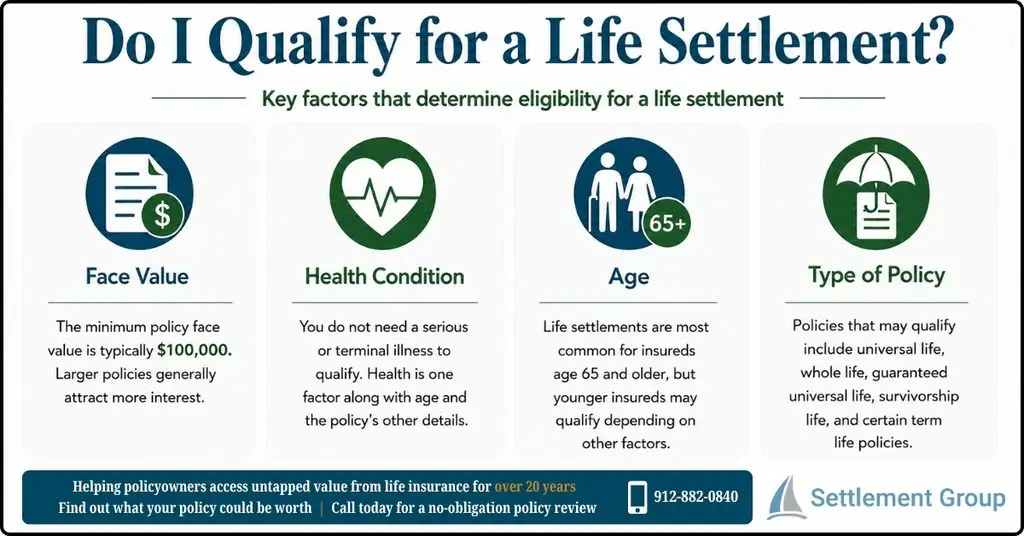
There is no single factor that determines eligibility. A policy that does not appear to qualify based on one factor may still qualify based on the insured’s health, age, or other policy details.
What Are the Basic Requirements for a Life Settlement?
Life settlements are evaluated individually, but potential purchasers generally consider several key factors:
- The insured’s age
- The insured’s current health and medical history
- The policy’s death benefit
- The type of life insurance policy
- Current and future premium requirements
- The policy’s current status
- Policy guarantees and other contract provisions
- The expected cost of maintaining the policy
The combination of these factors helps determine whether a policy may qualify and whether a potential purchaser is interested in making an offer.
What Is the Minimum Policy Face Value to Qualify?
The minimum policy face value to qualify for a life settlement is typically $100,000.
However, face value is only one qualifying factor. The insured’s age and health, policy type, premium requirements, and other policy characteristics are also considered.
Some policies with a face value below $100,000 may qualify for a viatical settlement if the insured has been diagnosed with a terminal illness.
Do I Need a Health Condition to Qualify for a Life Settlement?
No. You do not necessarily need to have a serious or terminal health condition to qualify for a life settlement.
Health is an important factor because it helps potential purchasers estimate the insured’s life expectancy, but it is considered together with age, premiums, death benefit, and other policy characteristics. An older insured may qualify without having a significant health condition.
This is particularly relevant when considering a life settlement for seniors. Many seniors explore life settlements because their insurance needs have changed or their premiums have become difficult to maintain, not because they have been diagnosed with a serious illness.
If the insured has been diagnosed with a terminal illness and has a life expectancy of two years or less, the policy may instead qualify for a viatical settlement.
What Age Do I Need to Be to Sell My Policy?
There is no single minimum age that guarantees eligibility for a life settlement.
Traditional life settlements are most common for insureds age 65 and older. However, age is only one part of the evaluation. A younger insured may qualify depending on health and other factors affecting the policy.
For this reason, someone should not assume that they are either too young or old enough to qualify based on age alone.
What Types of Life Insurance Policies May Qualify?
Several types of life insurance can potentially be sold through a life settlement, including:
- Universal life
- Guaranteed universal life
- Whole life
- Survivorship life
- Certain term life policies
If you’re asking, can I sell my universal life insurance policy, the answer depends on the specific policy. The insured’s age and health, death benefit, future premiums, policy guarantees, and other characteristics all contribute to the evaluation.
Term policies require additional consideration. Convertible term coverage may qualify if the policy can still be converted to permanent insurance. Non-convertible term policies rarely qualify, although a policy may qualify for a viatical settlement if the insured has been diagnosed with a terminal illness.
Which States Allow Life Settlements?
Life settlements are regulated primarily at the state level, so requirements differ depending on where the policy owner resides.
Most states have laws or regulations governing life settlement transactions. These laws can establish licensing requirements, consumer disclosures, privacy protections, rescission periods, and other requirements intended to protect policy owners.
A life settlement provider must be appropriately licensed where required to conduct a transaction in the policy owner’s state.
Can I Sell a Policy That’s Still in the Contestability Period?
No. A life insurance policy cannot be sold through a life settlement while it is still within the contestability period.
The contestability period generally lasts for the first two years after a life insurance policy is issued. This period is longer in some states. Once that period has ended, the policy may be eligible for a life settlement if it meets the other qualification requirements.
A policy approaching the end of its contestability period can still be reviewed so you can determine whether it may qualify once the required period has passed.
Does Cash Surrender Value Affect Whether I Qualify?
Cash surrender value can be considered during an evaluation, but a policy does not necessarily need substantial cash value to qualify for a life settlement.
A potential purchaser considers the policy’s death benefit, premiums, the insured’s life expectancy, policy guarantees, and other characteristics. These factors can give a policy value in the secondary market even when it has little or no cash surrender value.
This is one of the reasons it can be worthwhile to have a policy evaluated before surrendering it or allowing it to lapse.
What Can Prevent a Policy from Qualifying?
A policy may not qualify if it does not meet current purchasing criteria.
For example, future premiums may be too high, the insured’s estimated life expectancy may be too long, or certain policy provisions may make the policy less attractive to potential purchasers.
Eligibility can also change over time. Changes in the insured’s health, age, premiums, policy values, or purchasing criteria may affect a future evaluation.
A policy that does not qualify today may therefore be worth reevaluating in the future rather than simply allowing it to lapse.
How Do I Find Out if I Qualify for a Life Settlement?
The most reliable way to determine whether you qualify is to have the policy appraised.
The initial review generally considers basic information about the policy and the insured. If the policy appears to meet purchasing criteria, additional policy records and medical information may be obtained with your authorization so that a more complete evaluation can be performed.
Having your policy reviewed does not obligate you to sell it. If an offer is made, you can decide whether selling make sense for your situation.
Find Out Whether Your Policy May Qualify
If you are considering surrendering your life insurance, allowing it to lapse, or simply no longer need the coverage, find out whether it may qualify for a life settlement before giving it up.
Settlement Group can review your policy and help determine whether it meets current life settlement purchasing criteria. If it qualifies, you may be presented with an offer to consider.
Contact us today for a no-obligation policy review. 912-882-0840