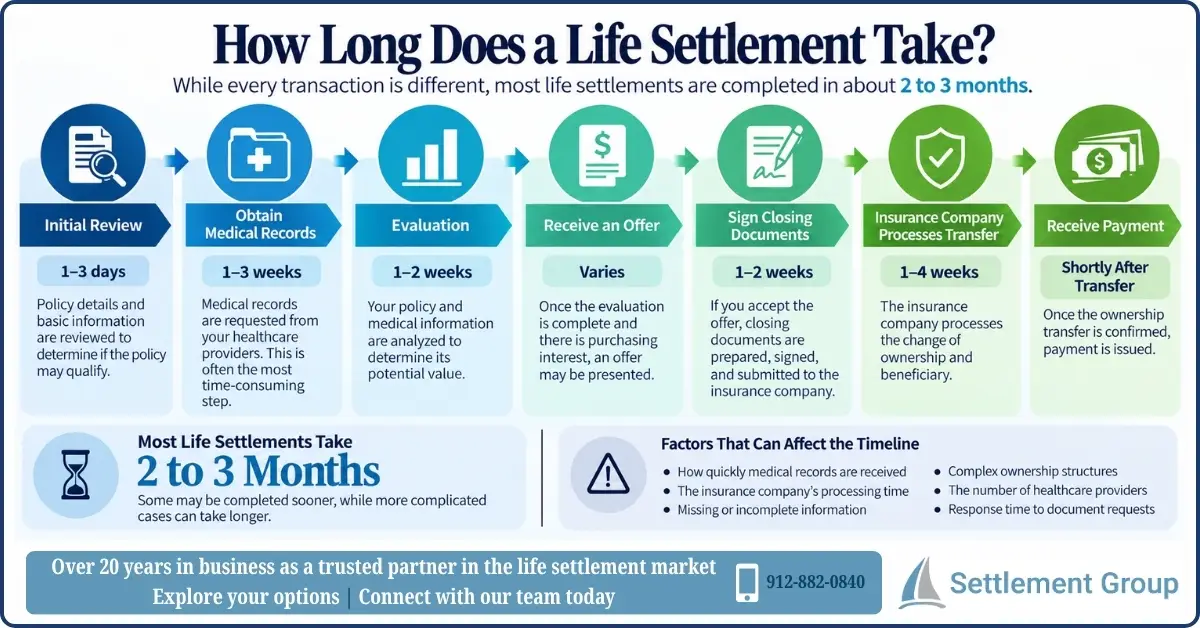
If you’re considering selling your life insurance policy, you may be wondering, how long does a life settlement take? A life settlement typically takes about 2–3 months to complete, although some transactions may close sooner and more complicated cases can take longer. The timeline depends on several factors, including how quickly medical records and policy information are obtained, the time needed to evaluate the policy, and how long the insurance company takes to process the ownership and beneficiary changes.
What Is the Typical Life Settlement Timeline?
Most policy owners should expect the life settlement process to take approximately 2–3 months from the initial review through closing and payment.
That timeframe is not a guarantee. Some transactions move more quickly, while others require additional time. Medical record delays, complex policy ownership, missing documentation, or longer processing times at the insurance company can all extend the timeline.
Several parts of the process may also happen at the same time. For example, policy information and medical records may be requested simultaneously rather than one after the other.
What Happens During the Initial Policy Review?
The process begins with a preliminary review of the policy and basic information about the insured.
Information such as the insured’s age and health, policy type, death benefit, and premium requirements can help determine whether the policy may be a candidate for a life settlement.
If the policy appears to qualify, the policy owner can authorize the collection of the more detailed information needed for a full evaluation.
How Long Does It Take to Get Medical Records?
Obtaining medical records is often one of the biggest variables in the life settlement timeline.
A medical record request may need to be submitted to multiple physicians, hospitals, specialists, or other healthcare providers. Some offices respond quickly, while others may take considerably longer.
Generally, the insured does not need to undergo a new medical examination. The evaluation is based on existing medical records, which is why obtaining complete records can have such a significant effect on how quickly the transaction progresses.
How Long Does It Take to Receive a Life Settlement Offer?
Before an offer can be determined, sufficient medical and policy information must be obtained and evaluated.
The evaluation considers information about the insured as well as the policy’s death benefit, premiums, guarantees, and other policy characteristics that can affect its value.
Once the necessary information has been reviewed and there is purchasing interest, an offer may be presented to the policy owner. Receiving an offer does not obligate you to accept it.
What Happens After I Accept a Life Settlement Offer?
Accepting an offer begins the closing portion of the transaction.
Closing documents are prepared and provided for review and signature. Additional documentation may also be required depending on the policy, ownership structure, and transaction.
Once the necessary documents have been completed, the appropriate paperwork is submitted to the life insurance company to process the ownership and beneficiary changes.
How Long Does the Insurance Company Take to Transfer Ownership?
Insurance company processing time is another major factor in how long a life settlement takes.
Processing times vary by carrier. Some insurance companies complete ownership and beneficiary changes relatively quickly, while others may take several weeks or longer.
Because this part of the transaction depends on the insurance company, neither the policy owner nor the life settlement provider has complete control over how quickly it is completed.
When Will I Receive My Life Settlement Payment?
Once the ownership and beneficiary changes have been processed and confirmed by the insurance company, the transaction can proceed to payment. Settlement proceeds are then released to the policy owner, completing the life settlement transaction.
What Can Delay a Life Settlement?
Several factors can cause a transaction to take longer than the typical 2–3 month timeframe. One of the most common is waiting for medical records, particularly when records must be collected from several healthcare providers.
Other potential delays include incomplete authorization forms, missing policy information, additional documentation requests, complex ownership arrangements, and longer processing times at the life insurance company.
More complicated cases may require additional review or documentation, which can extend the process beyond the typical timeframe.
Can I Speed Up the Life Settlement Process?
Although some parts of the process depend on third parties, there are things you can do to help prevent unnecessary delays.
Providing complete and accurate information at the beginning, signing authorization forms promptly, identifying all relevant healthcare providers, and responding quickly to requests for additional information can help keep the transaction moving.
It can also be helpful to begin the process before there is an urgent need for the proceeds. This allows time for medical records, policy information, evaluation, closing, and insurance company processing without relying on a specific completion date.
Find Out Whether Your Policy May Qualify
A life settlement typically takes about 2–3 months, but every transaction is different. Some may be completed sooner, while more complicated cases can take longer.
An initial policy review can help determine whether your policy may qualify and what information will be needed to begin the evaluation.
Contact us today for a no-obligation policy review. 912-882-0840