If you’re considering selling your life insurance policy, understanding the differences between a life settlement vs viatical settlement can help you determine which option may apply to your situation. Both allow a policy owner to sell an existing life insurance policy for a lump-sum payment. The primary difference involves the insured’s health and life expectancy. Traditional life settlements generally involve older insureds, while viatical settlements involve individuals with qualifying serious illnesses, with less emphasis on age.
What Is the Difference Between a Life Settlement and a Viatical Settlement?
Both involve selling a life insurance policy to a third party. The buyer assumes ownership, becomes responsible for future premiums, and receives the death benefit when the insured passes away. However, the circumstances surrounding each transaction differ. So, what is a life settlement?
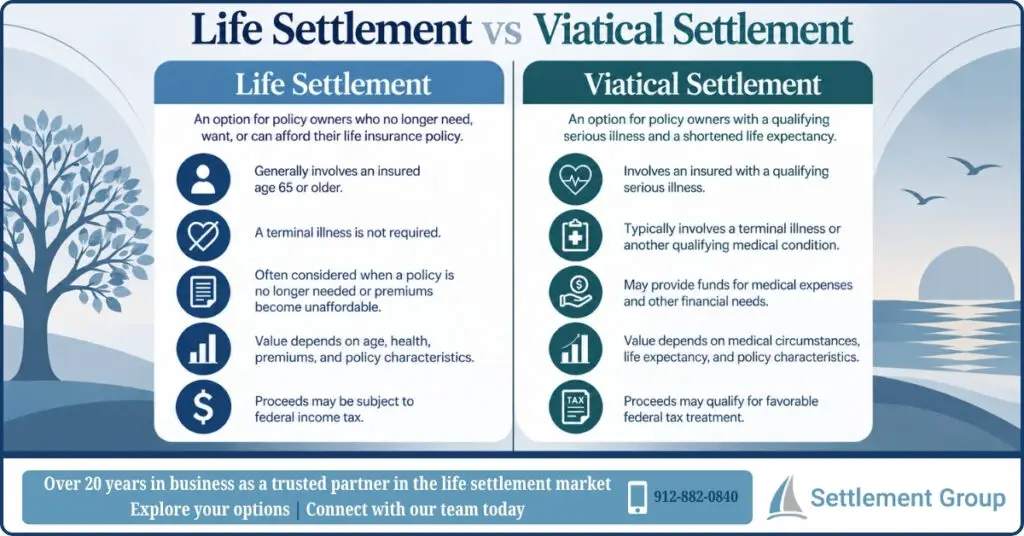
Life Settlement
- Generally involves an insured age 65 or older.
- Does not require a terminal illness.
- Often considered when a policy is no longer needed or premiums become unaffordable.
- Value depends on age, health, premiums, and policy characteristics.
- Proceeds may be subject to federal income taxes.
Viatical Settlement
- Involves an insured with a qualifying serious illness.
- Typically involves a terminal illness or another qualifying medical condition.
- May provide funds for medical expenses and other financial needs.
- Value depends on medical circumstances, life expectancy, and policy characteristics.
- Proceeds are often not subject to tax. Always consult with your trusted tax advisor.
Terminology and requirements vary by state. Some states regulate both transactions under viatical settlement laws.
Who Qualifies for a Life Settlement?
Traditional life settlements generally involve insureds age 65 or older, although younger individuals may qualify depending on their health. Eligibility depends on the insured’s age and medical history, the policy’s death benefit, premium requirements, and other policy characteristics.
The typical minimum death benefit is $100,000. Universal life, guaranteed universal life, whole life, survivorship, and certain term life insurance policies may qualify. A serious illness is not required, but typically health has slipped since the policy was originally taken out.
Who Qualifies for a Viatical Settlement?
A viatical settlement involves an insured with a qualifying serious illness and shortened life expectancy. Unlike traditional life settlements, eligibility is not necessarily restricted by age. A younger individual diagnosed with a qualifying illness may be eligible.
Policies with death benefits below the typical $100,000 minimum for traditional life settlements may also qualify. Eligibility is determined through a review of medical records and policy information.
Why Do Policy Owners Consider These Settlements?
The reasons for selling a policy often differ depending on the insured’s circumstances.
Reasons for Choosing a Life Settlement
Policy owners may consider a life settlement when premiums become unaffordable, the original need for the policy has changed, or additional funds are needed for retirement or other financial priorities. Some are considering surrendering their policies or allowing them to lapse.
A life settlement may provide exponentially more money than the policy’s cash surrender value.
Reasons for Choosing a Viatical Settlement
A viatical settlement is often considered following a serious medical diagnosis. Proceeds can help pay for medical treatment, caregiving, household expenses, or other financial obligations.
Is a Viatical Settlement Worth More Than a Life Settlement?
Neither transaction automatically produces a higher payout. Offers depend on the death benefit, future premium requirements, the insured’s life expectancy, and other policy characteristics.
A shorter life expectancy may increase an offer because fewer future premium payments may be required. However, every policy must be evaluated individually before its potential settlement value can be determined.
Are Life Settlement and Viatical Settlement Proceeds Taxed Differently?
Life settlement proceeds may be subject to federal income tax, while viatical settlement proceeds may qualify for tax-free treatment under certain circumstances.
Tax treatment depends on the individual transaction. Consult your tax professional to determine how the proceeds may be taxed.
Does the Settlement Process Differ?
The basic process is similar for both transactions. The policy owner authorizes the collection of medical records and policy information, which are reviewed to determine eligibility and potential value. If an offer is presented, the policy owner decides whether to accept it.
Following acceptance, closing documents are prepared and signed. The insurance company then processes the ownership and beneficiary changes. Once the transfer has been completed and confirmed, payment is issued.
The process is largely the same for both, but eligibility and policy valuation depend on the insured’s health and life expectancy.
Can I Choose Between a Life Settlement and a Viatical Settlement?
The appropriate transaction depends on the insured’s circumstances and applicable requirements, rather than the policy owner’s preference. An older insured without a qualifying serious illness may be eligible for a traditional life settlement, while someone with a qualifying terminal illness may be eligible for a viatical settlement regardless of age.
A preliminary policy review can help determine which option may be available.
Find Out Whether Your Policy Qualifies
Whether you’re considering a life settlement or viatical settlement, Settlement Group can review your policy, determine whether it may qualify, and present an offer when available. We work directly with policy owners and coordinate transactions through closing.
Contact us today for a no-obligation policy review. 912-882-0840