If your term life insurance policy is approaching the end of its coverage period, understanding your term life insurance expiring options can help you make the most of the coverage you’ve maintained for years. Depending on your policy, you may be able to renew your coverage, convert it to permanent life insurance, purchase a new policy, or even sell your existing coverage for cash through a life settlement.
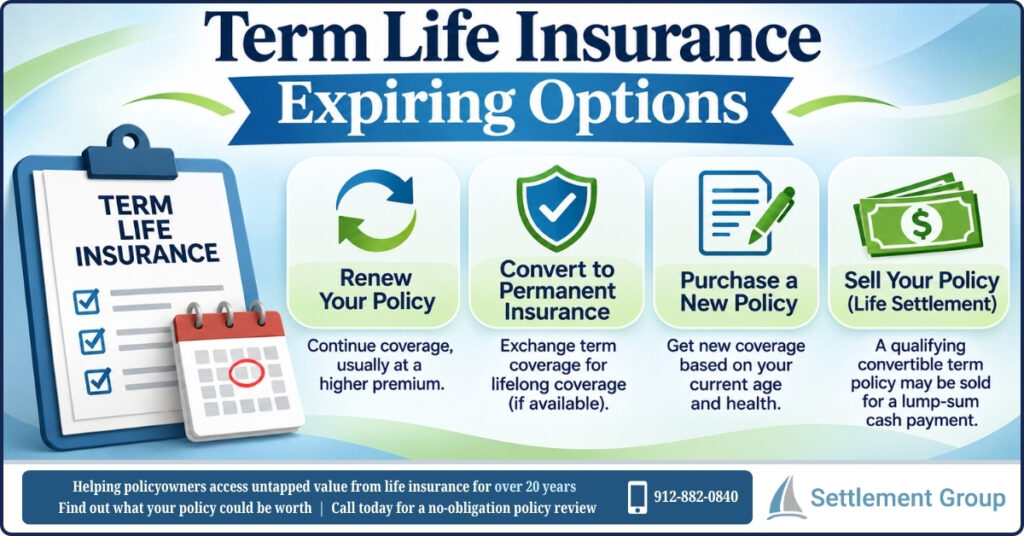
The right choice depends on your current insurance needs, the cost of maintaining coverage, and the provisions of your policy. Before allowing your term life insurance to expire, it’s worth reviewing the options available to you, especially if your policy includes a conversion privilege.
What Happens When Term Life Insurance Expires?
Term life insurance provides coverage for a specified period, commonly 10, 15, 20, or 30 years. If the insured passes away while the policy is active, the insurance company pays the death benefit to the designated beneficiaries. Once the level term period ends, however, the policy may terminate or continue under different premium terms, depending on the contract.
Some policies allow coverage to continue through annual renewals, although premiums can increase substantially after the initial term, skyrocketing up each year. Others terminate at the end of the coverage period unless the owner takes action before the expiration date. If the policy ends, there is no longer a death benefit available to beneficiaries, and the premiums paid over the years are not refunded.
Option 1: Renew Your Term Life Insurance Policy
Some term life insurance policies include a renewal provision that allows coverage to continue without requiring a new medical examination. This can be beneficial if your health has changed since you originally purchased the policy and obtaining new coverage would be difficult.
The primary consideration is cost. Renewal premiums are typically based on the insured’s current age and may increase significantly after the original level term period ends. In some cases, the cost of maintaining the same death benefit becomes unaffordable. Reviewing the renewal schedule before your term expires can help you determine whether continuing coverage makes financial sense.
Option 2: Convert Your Term Policy to Permanent Life Insurance
Many term life insurance policies include a conversion privilege that allows the owner to exchange term coverage for permanent life insurance, such as universal life or whole life. Conversion can be especially valuable because qualifying policies can often be converted without new medical underwriting, even if the insured’s health has declined.
Permanent life insurance is designed to provide coverage beyond the original term, provided the policy remains in force under its contract terms. However, conversion typically results in higher premiums, and the available permanent policy options depend on the insurance company.
One of the most important things to check is your policy’s conversion deadline. Some policies allow conversion until the end of the level term period, while others require conversion by a certain age or an earlier date. Missing that deadline could eliminate an option that may have significant financial value.
Option 3: Purchase a New Life Insurance Policy
If you still need life insurance protection, purchasing a new policy may be another option. A new term policy could provide coverage for an additional 10, 15, or 20 years, depending on your age, health, and the products available from insurance companies.
Unlike converting an existing policy, purchasing new coverage typically requires underwriting based on your current health. Premiums may be considerably higher than when you first obtained coverage, particularly if you have developed medical conditions. Comparing the cost of a new policy with your existing renewal or conversion options can help you determine which approach offers the coverage you need at a reasonable price.
Option 4: Sell Your Term Life Insurance Policy Through a Life Settlement
Many policy owners are surprised to learn that certain term life insurance policies can be sold for cash rather than allowed to expire. A life settlement allows a qualifying policy owner to transfer ownership of an existing life insurance policy to a purchaser in exchange for a lump-sum payment.
Convertible term life insurance policies may qualify for a life settlement, particularly when the insured is older or has experienced changes in health. The ability to convert the policy into permanent coverage can make it attractive to a purchaser who is willing to assume the cost of conversion and future premiums.
Life settlement eligibility depends on several factors, including:
- Age and health: Traditional life settlements are typically for insureds age 65 or older, although younger individuals with significant health conditions may qualify.
- Death benefit: Policies typically need a face value of at least $100,000, although some smaller policies may still qualify for viatical settlements.
- Conversion rights: A convertible term policy may have settlement value even when it has no cash surrender value.
- Premium costs: The expense of converting and maintaining the policy affects its potential settlement value.
- Conversion deadline: The policy typically must still have conversion rights available.
Non-convertible term policies rarely qualify for traditional life settlements. However, if your term policy includes a conversion privilege, it may be worth having the policy evaluated before that option expires.
What If My Term Life Insurance Has Already Expired?
If your term life insurance policy has already terminated, selling it through a life settlement is usually no longer an option. A life settlement requires an existing policy that can be transferred to a purchaser, so timing is especially important when coverage is approaching expiration.
However, if the policy has recently lapsed, contact the insurance company to determine whether reinstatement is possible. Reinstatement rights and requirements vary by contract and may involve overdue premiums, evidence of insurability, or other conditions. Restoring coverage does not automatically restore an expired conversion privilege, so both issues should be reviewed with the insurer.
How Do I Know Which Option Is Best?
Choosing among your term life insurance expiring options starts with determining whether you still need the death benefit. If your family depends on the coverage for financial protection, renewal, conversion, or purchasing a new policy may be appropriate. If your financial circumstances have changed and the coverage is no longer necessary, selling a qualifying policy could provide value that would otherwise be lost when the term expires.
Review your policy’s expiration date, conversion deadline, renewal premiums, and available coverage options before making a decision. If your policy is convertible, requesting a life settlement evaluation can help you understand whether it has potential value before you allow it to terminate.
Explore Your Term Life Insurance Expiring Options
If your term life insurance is nearing expiration, you may have more options than simply renewing the policy or allowing it to end. A convertible term policy could qualify for a life settlement, allowing you to receive a cash payment for coverage you no longer need or want.
Settlement Group has more than 20 years of experience in the life settlement industry and works directly with policy owners to evaluate existing life insurance coverage. Our team reviews policy eligibility, presents offers when available, coordinates funding, and oversees transactions through closing. Working directly with Settlement Group means there are no separate broker fees deducted from your settlement proceeds.
Before your term life insurance expires or your conversion privilege ends, give us a call for a no-obligation policy review. 754-296-9034